Key points
- The third COP31 draft, dated 22 November, recalls the 2023 Dubai deal but never uses the words fossil fuels.
- It expresses deep concern that warming will exceed 1.5C within years and sets a 35% electrification goal for 2035.
- Countries only agree to discuss a pathway to triple adaptation finance; an earlier $120 billion target is gone.
- An EU official called the draft backwards; the closing plenary was delayed and no deal had been adopted by 15:20 WIB.
- Indonesia sought no new obligations; WALHI says 80 of Indonesia's 120 GW of power capacity is still coal.
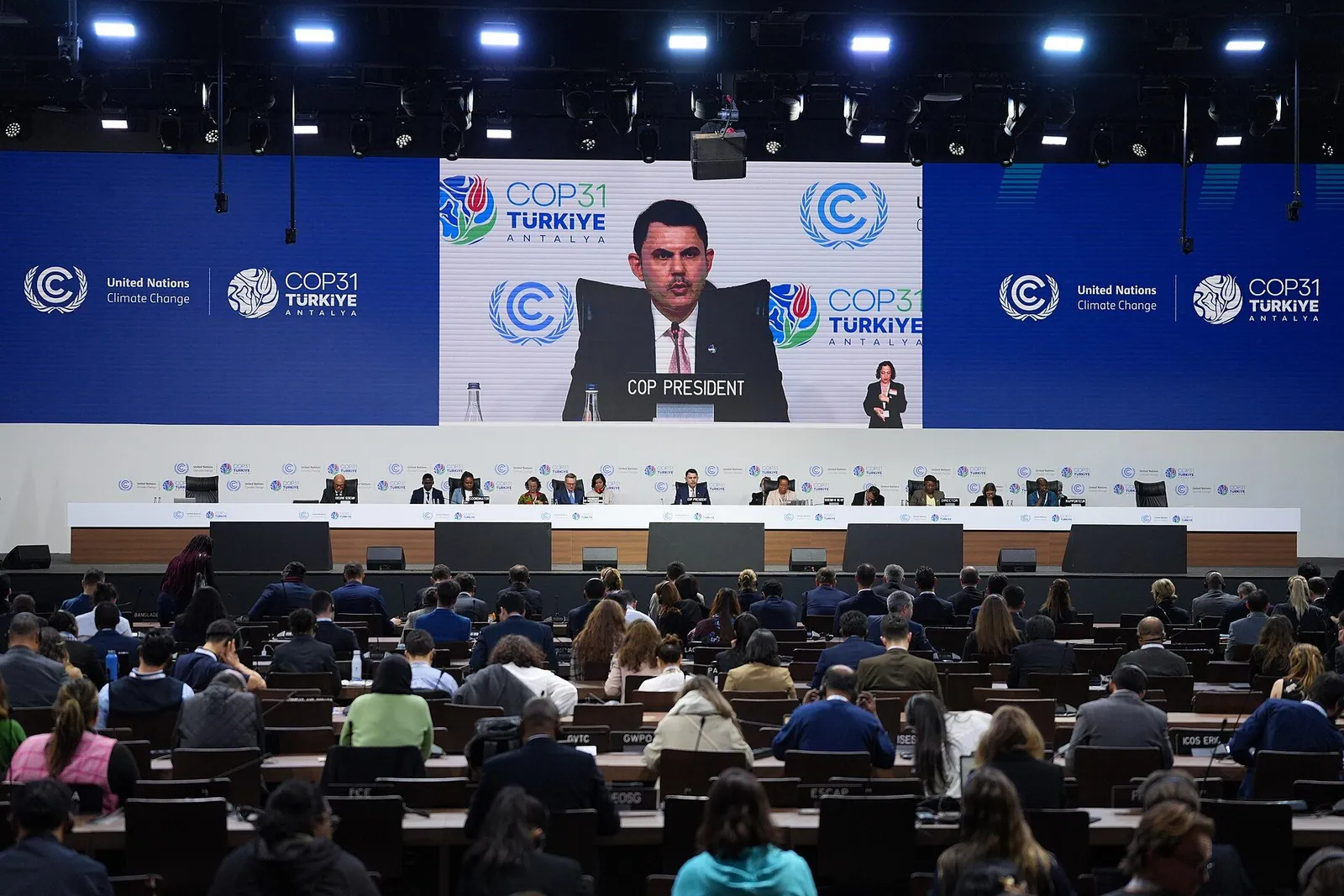
Negotiators at the UN climate summit in Antalya, Türkiye, were weighing a third and possibly final draft deal on Sunday, 22 November, that would recognise global warming overshooting 1.5C, which Reuters says would be a first for a COP deal, but that does not mention fossil fuels once. The European Union, small island states and campaigners criticised the text, and the closing session that was meant to adopt it was repeatedly delayed.
As of about 15:20 Western Indonesia Time (08:20 GMT) on Sunday, the closing plenary had not begun and no deal had been adopted, according to the Guardian's live reporting from the venue. The session was first set for 9am Turkish time, then moved to 10am, then 11am, and the UNFCCC website later listed 11:30am (15:30 WIB), the Guardian reported. COP decisions need consensus among nearly 200 countries, so a single objection can block the text.
What the new draft says
The draft cover decision, published by the UNFCCC with a timestamp of 2:00 on 22 November, opens by "recalling the United Arab Emirates Consensus in its entirety". That is a reference to the COP28 deal in Dubai in 2023, the only UN climate cover agreement in which countries agreed to transition away from fossil fuels. The words "fossil fuels" themselves do not appear anywhere in the new text, a NewsWLD search of the document shows.
The draft "expresses deep concern that peak global warming is expected to exceed 1.5C above pre-industrial levels in the next few years" and recognises that "1.5C overshoot" will increase loss and damage. Reuters and the BBC reported that this would be the first time a COP agreement acknowledged that the Paris goal is on course to be missed.
Other key provisions in the text:
- A global goal to raise the share of electricity in total final energy consumption to 35% by 2035, alongside efforts to increase clean energy.
- Accelerating carbon capture, utilisation and storage (CCUS) "with an aim to achieve gigatonne scale globally by 2035 as a collective global aspiration".
- A welcome for efforts to "urgently and rapidly scale up" carbon dioxide removal technologies, which the text says should complement, not delay, emission cuts.
- On adaptation money, countries only "agree to discuss" an implementation pathway for tripling adaptation finance by 2035 at next year's COP, and launch an "Antalya-Addis Ababa road map" on adaptation finance. There is no dollar figure. An earlier draft had set a $120 billion target, according to AFP and the BBC.
The draft itself cites estimates that developing countries need about $305 billion a year for adaptation until 2035, and notes "with concern the gap between climate finance flows and needs".
Who objects, and why
An EU official told AFP the latest proposal was a "backwards" step and warned of a "very real possibility" that COP31 ends with no deal. "I am more pessimistic today than I was yesterday," the official said. A German official told AFP that "the oil-producing countries are putting up a fierce fight". A Saudi official declined to comment to AFP; Reuters said a Saudi delegation representative also declined to comment.
Observers to the closed-door talks told Reuters that Saudi Arabia and other large oil producers had pushed hard to keep fossil fuels out of the text and carbon removal in. That account comes from observers, not from the Saudi delegation.
Antigua and Barbuda's environment minister, Michael Joseph, told AFP he was "very disappointed" and could not "honestly say that I'm okay with it passing" in its current form. Bill Hare, chief executive of Climate Analytics and a long-time adviser to small island states, told the Guardian there was "widespread unhappiness" with the text among small island states, least developed countries, the EU and the Environmental Integrity Group, but that he did not know whether anyone would block it.
Campaigners were sharper. Harjeet Singh of the Fill the Fund campaign said donor countries had "deleted every number that would show whether they have" paid. Greenpeace's delegation head, Jasper Inventor, said "no deal is better than a deal with the fossil fuel industry". Sara Shaw of 350.org told Reuters carbon capture was "one of the biggest scams of the overshoot era".
The presidency's case
COP31 president Murat Kurum, Türkiye's environment minister, told delegates early on Sunday: "We believe that we have put forward a text which all the parties can agree upon," Reuters reported. Anadolu reported that he said the text includes fossil fuel language so the summit does not retreat from the Dubai commitments, and also addresses adaptation finance. Australia's climate and energy minister Chris Bowen, who leads the negotiations, has argued the summit should focus on implementation and the shift to clean energy, the BBC reported.
Those are the presidency's descriptions. The text itself contains no explicit fossil fuel wording, and its finance section sets a process rather than a new amount.
What it means for Indonesia
Indonesia's publicly stated position asked for the Dubai deal to remain the reference point, not for new fossil fuel commitments. At a heads of delegation meeting on the cover decision on 17 November, Irawan Asaad, a director at the Environment Ministry (KLH/BPLH), said the decision should not create new obligations or reporting burdens for developing countries, according to a ministry statement. Indonesia proposed the wording "encourages, as appropriate" to leave room for national circumstances, asked that the Dubai deal remain the reference point for the energy transition, and said the term "1.5C overshoot" should be used selectively. The third draft's indirect reference to the Dubai deal is close to what Indonesia asked for.
Indonesian environmental group WALHI says that leaves a gap at home. In a statement on 20 November it said about 80 GW of Indonesia's 120 GW of power capacity still runs on coal, so a 35% electrification target "means nothing" if the power comes from coal and the nickel from natural forests. WALHI also criticised the 19 November draft for cutting language on free, prior and informed consent (FPIC) for Indigenous peoples. The new draft refers to Indigenous peoples' rights under the UN declaration (UNDRIP) but does not mention FPIC explicitly. WALHI urged Indonesia's delegation to press for a fossil fuel transition commitment and direct climate finance for local communities. The ministry's statement predates WALHI's; we did not find a published ministry response to the group's criticism.
What happens next
If no consensus is reached, the talks could be suspended until next year, which the BBC said has happened only once since COPs began in 1995. The 2019 Madrid summit ran 44 hours over time before closing, the Guardian noted. NewsWLD will update this story when the plenary decides.
Sources
- 1.UNFCCC: Draft text, Presidency-led cover decision (version 22/11/2026 2:00), docs.unfccc.int
- 2.Reuters via Investing.com: COP31 climate talks close to final deal, says summit president (22 Nov 2026), investing.com
- 3.AFP: Fossil fuels still missing from latest COP31 draft deal (22 Nov 2026), afp.com
- 4.BBC: New draft deal aims to avert collapse of talks at COP31 climate summit (22 Nov 2026), bbc.com
- 5.The Guardian: Cop31 live, a new draft deal on the table as talks go into final hours (22 Nov 2026), theguardian.com
- 6.Anadolu: Head of COP31 says gap narrowing on final text (22 Nov 2026), aa.com.tr
- 7.Al Jazeera: Fossil fuel impasse pushes COP31 climate talks into second day of overtime (22 Nov 2026), aljazeera.com
- 8.KLH/BPLH: Di Konferensi Iklim Dunia, Indonesia Tegaskan Aksi Nyata Harus Didukung, Bukan Dibebani Kewajiban Baru (18 Nov 2026), kemenlh.go.id
- 9.WALHI: COP31 di Ujung Kegagalan, Draf Keputusan Buang Hak Rakyat dan Pertahankan Solusi Palsu (20 Nov 2026), walhi.or.id