Key points
- Indonesia and the EU are scheduled to sign the CEPA and an investment protection agreement in Brussels on 21 November; no official confirmation of the signature had been published at the time of writing.
- Indonesia loses EU GSP tariff preferences on 1 January 2027, but neither side has fixed a date for provisional application.
- The investment deal has no investor-state mechanism yet, but both sides commit to negotiate one within three years.
- IGJ, WALHI, Fern and CELIOS raise concerns over generic medicines, transparency, palm oil and deforestation rules.
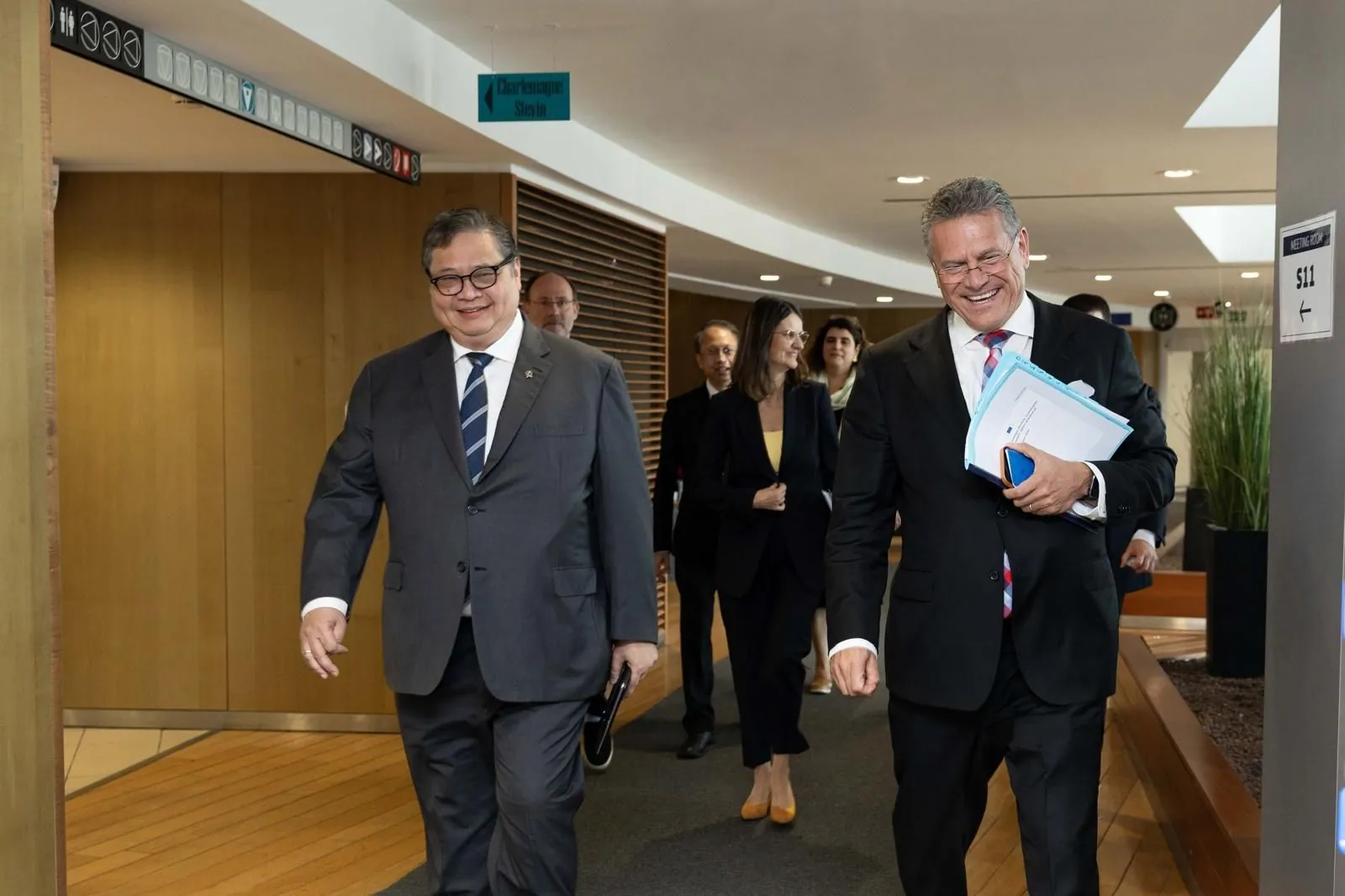
Indonesia and the European Union are scheduled to sign their Comprehensive Economic Partnership Agreement (CEPA) and a separate Investment Protection Agreement (IPA) in Brussels on Saturday, 21 November, a milestone in talks launched in July 2016. The European Commission's public calendar lists Trade Commissioner Maroš Šefčovič signing both texts with Coordinating Economic Minister Airlangga Hartarto and Trade Minister Budi Santoso. When this article was written, on Saturday afternoon Jakarta time (morning in Brussels), NewsWLD had not found an official statement from either side confirming that the signatures had taken place.
The signing is not the finish line. The texts still need the consent of the European Parliament and ratification by Indonesia before they can enter into force, according to the European Commission. And the clock is running: Indonesia is due to lose its preferential tariffs under the EU's Generalised Scheme of Preferences (GSP) on 1 January 2027.
What exporters are promised
The two governments describe the scale of the deal differently. According to Indonesian government figures reported by ANTARA and CNBC Indonesia on Friday, the agreement liberalises more than 98% of bilateral trade and 90.4% of Indonesian tariff lines will get zero tariffs immediately. The European Commission says tariffs will be eliminated on more than 98% of tariff lines, with 80% liberalised at entry into force and 96% of trade after a five-year phase-out. The figures measure different things, so readers should not treat them as directly comparable.
For Indonesia, the Commission names palm oil, textiles and footwear as the main winners. For the EU, it names agri-food, chemicals, machinery and cars: Indonesia will remove 98.5% of its tariffs on EU goods, including car tariffs of up to 50%, mostly over five years, saving EU exporters an estimated €600 million a year in duties. Johni Martha, the Trade Ministry's director general for international trade negotiations, said on 16 November that the deal protects labour-intensive industries and small businesses that export to Europe, ANTARA reported.
Bilateral trade in goods and services reached €28.9 billion in 2025, according to the EU Council figures cited by The Diplomat. The EU is Indonesia's fourth-largest trading partner, while Indonesia ranks only 30th among the EU's partners. The Diplomat linked the speed of the final push to US tariffs: Indonesia was hit with a 32% rate in April 2025, cut to 19% in a deal signed in February 2026.
A deadline the governments have not pinned down
EU governments authorised the signing and provisional application of both agreements on 18 November. Ireland's trade minister, Helen McEntee, whose country holds the Council presidency, said "fast execution was critical" because of the GSP graduation on 1 January 2027. Airlangga and Šefčovič discussed provisional application "in early 2027", subject to each side's legal procedures, according to ANTARA.
Neither side has published a firm start date. After graduation, Indonesian exports will no longer benefit from GSP preferential tariffs, The Diplomat reported, citing the Council. If provisional application begins after 1 January, goods that now enter under those preferences would face standard EU duties in the gap. That is the first test of the government's promise of quick benefits for exporters.
Investor protection and the ISDS question
Civil society groups have long argued that the investment deal tilts power towards corporations. A 2024 joint paper by WALHI (Friends of the Earth Indonesia) and Indonesia for Global Justice (IGJ) warned that investor-state dispute settlement (ISDS), or the EU's Investment Court System, would let investors sue the state over environmental and community protections. In February 2025 more than 120 European and Indonesian organisations urged both sides to end the talks, citing risks to Indigenous peoples and the environment, Human Rights Monitor reported.
The final IPA, as the Commission describes it, does not yet contain an investor-state mechanism. Disputes go through state-to-state settlement, and the two sides commit to negotiate an investor-state system after entry into force, aiming to finish within three years. The critics' concern therefore has not gone away; it has been postponed.
Medicines, palm oil and nickel
IGJ's February 2026 analysis of the intellectual property chapter says the agreed text keeps the core of data exclusivity, which would bar Indonesia's drug regulator BPOM from relying on an originator's clinical data to approve generics without consent, with the length left to national law. It also flags Article 12.39 on "effective" patent protection and customs border measures that cover patents, which IGJ says could delay or block cheaper generic medicines.
On palm oil, the agreement includes a palm oil protocol and a dialogue platform, according to the Commission. Fern, a forest and rights group with an office in Brussels, said in April 2026 that the deal cuts tariffs on palm oil and other forest-risk commodities and eases investment without adding safeguards against conflicts between companies and communities, and urged the EU to enforce its deforestation regulation (EUDR). When the deal was concluded in September 2025, CELIOS executive director Bhima Yudhistira told DW that "without credible sustainability compliance and a trusted traceability system, zero tariffs will be difficult to utilize". Eddy Martono, chairman of the Indonesian Palm Oil Association (GAPKI), told DW that smallholders, not big companies, face the real EUDR challenge because the government had yet to give clear rules on their land.
The Commission says the CEPA will give EU manufacturers "stability and predictability" in access to Indonesian nickel and cobalt. It also bans export monopolies and dual pricing for raw materials and limits unjustified price interventions. The EU summaries NewsWLD reviewed do not explain in detail how these rules fit with Indonesia's ban on raw nickel ore exports, a policy that Human Rights Monitor says stalled the negotiations and that The Diplomat lists among the disputes that slowed them.
Transparency and what comes next
WALHI and IGJ said in their 2024 paper that the Indonesian government had not carried out impact studies on the social, environmental and Indigenous rights effects of the deal, and that negotiating documents were not made public. They cited Constitutional Court ruling No. 13/PUU-XVI/2018, which they say makes public participation in treaty-making a legal requirement. On the EU side, the Commission points to binding labour and environment commitments, domestic advisory groups and a civil society forum to monitor implementation.
The questions to watch now are when Indonesia's ratification reaches the House of Representatives, whether the full texts and an impact assessment are published in Indonesian before that vote, and whether provisional application is in place before the GSP preferences expire on 1 January. NewsWLD will update this story when either government confirms the signing.
Sources
- 1.European Commission: Calendar items of the President and Commissioners (21 Nov 2026), commission.europa.eu
- 2.ANTARA: Indonesia, EU finalize IEU-CEPA preparations ahead of signing (20 Nov 2026), en.antaranews.com
- 3.CNBC Indonesia: IEU-CEPA diteken hari ini, Menko Airlangga matangkan implementasi (21 Nov 2026), cnbcindonesia.com
- 4.ANTARA: RI siap tandatangani IEU-CEPA pada 21 November di Brussel (16 Nov 2026), antaranews.com
- 5.The Diplomat: EU governments sign off on previously-agreed trade deal with Indonesia (20 Nov 2026), thediplomat.com
- 6.Government of Ireland: Statement by Minister Helen McEntee on Council authorisation of the EU-Indonesia agreements (18 Nov 2026), gov.ie
- 7.European Commission: Key elements of the EU-Indonesia Trade Agreement and Investment Protection Agreement, policy.trade.ec.europa.eu
- 8.European Commission: Factsheet, EU-Indonesia CEPA main benefits, policy.trade.ec.europa.eu
- 9.IGJ: Kertas analisis bab kekayaan intelektual dalam I-EU CEPA (21 Feb 2026), igj.or.id
- 10.WALHI and IGJ joint position paper: IEU CEPA, a threat to the environment, Indigenous peoples and biodiversity (2024), igj.or.id
- 11.Human Rights Monitor: Civil society urges review of EU-Indonesia trade deal (26 Feb 2025), humanrightsmonitor.org
- 12.Fern: The EU-Indonesia CEPA and IPA, what they mean for forests and people (2 Apr 2026), fern.org
- 13.DW: Indonesia palm oil sellers fear new barriers after EU deal (23 Sep 2025), dw.com