Key points
- Article 8(2) of the 1945 Constitution limits the president to two vice-presidential nominees.
- The MPR has up to 60 days from Gibran's 12 November resignation, about 11 January 2027.
- The vote moved from 2 to 9 December at Prabowo's proposal, then to 11 December.
- Prabowo said he consulted only coalition parties and Gerindra's leadership.
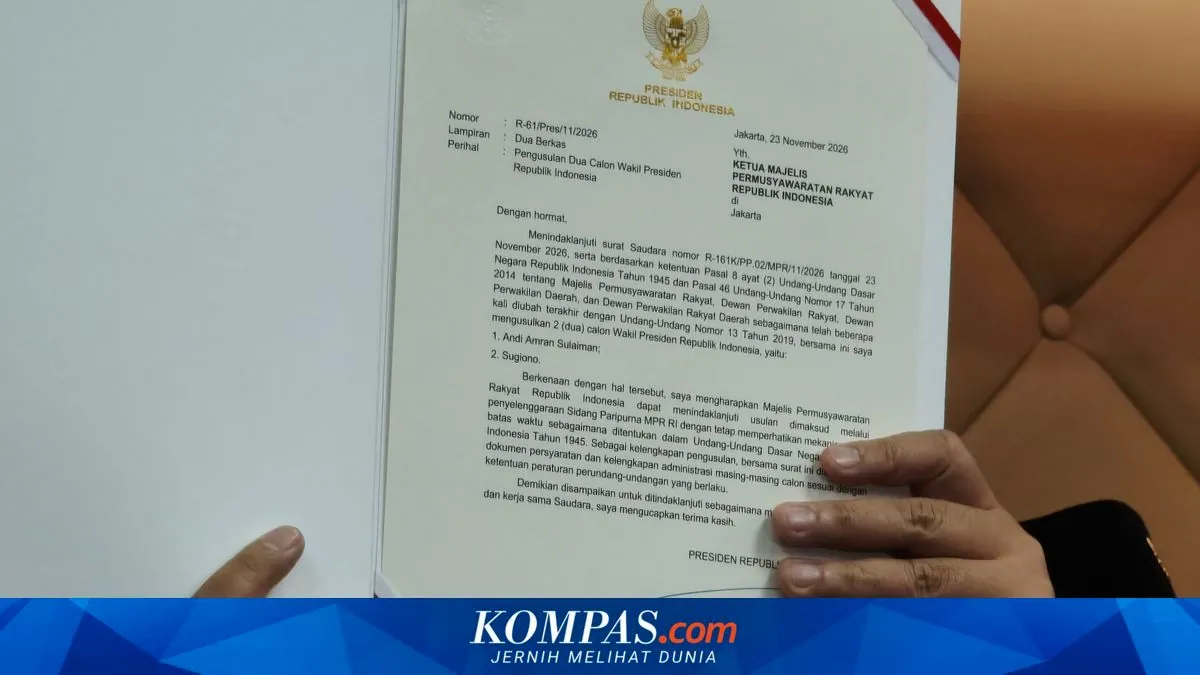
The claim: "I want to stress that this does not mean only these two people qualify. There are many good ones. But our constitution stipulates that I may only propose two names, and I was given very limited time. I could not consult for too long." President Prabowo Subianto, after handing his two vice-presidential nominees to the People's Consultative Assembly (MPR) at the parliament complex in Jakarta on 23 November 2026, as reported by Kompas.
Verdict: Partly true. The two-name rule is real. The claim that he was "given very limited time" is overstated: the constitution allows up to 60 days after a vacancy, the MPR moved its vote back at Prabowo's own request, and he submitted his nominees inside the extended window.
What the record shows
-
Two names is a constitutional rule. Article 8(2) of the 1945 Constitution says the MPR must meet within 60 days of a vice-presidential vacancy to choose a vice president from two candidates proposed by the president. (Tirto)
-
The vacancy began on 12 November. Gibran Rakabuming Raka formally resigned by letter to the MPR leadership on Thursday 12 November 2026. Sixty days from that date runs to about 11 January 2027. (Tirto)
-
The first, tight timetable was set by the MPR, not the constitution. In a letter dated 13 November the MPR scheduled the vote for 2 December. Under the rule that names must arrive at least 14 days before the session, that meant Prabowo's names were due by 18 November. (MPR RI)
-
Prabowo asked for, and got, more time. MPR Speaker Ahmad Muzani said on 16 November that the vote was moved to 9 December "at the proposal of President Prabowo Subianto" because of his busy state schedule, and that the delay gave the president extra time to weigh his nominees and consult coalition parties. (MPR RI)
-
The vote was then moved a second time. On the morning of 23 November the MPR leadership moved the plenary again, to 11 December, citing the MD3 law's rule that names be submitted at least 14 working days before the vote. Prabowo handed over Andi Amran Sulaiman and Sugiono that afternoon. (Tirto)
-
The consultation he described was narrow. Prabowo said he had consulted the coalition parties in parliament and the Gerindra party leadership, adding: "And this is my decision." (Kompas)
How the deadline was built
The pressure on Prabowo came from a sequence of choices by the MPR, not from the constitution's 60-day limit. On 13 November, the day after Gibran's letter, Muzani announced the 2 December date, and the MPR leadership wrote to Prabowo asking for two names within 14 days of receiving the letter. (Tirto) Constitutional law scholar Bivitri Susanti of the Jentera School of Law said at the time that the choice was "entirely up to Prabowo", because he no longer needed to weigh a candidate's electability or the balance of political and economic forces as he did in 2024. (Tirto)
Gugun El Guyanie, head of the constitutional law programme at UIN Sunan Kalijaga Yogyakarta, said picking Sugiono, a close loyalist, risked reinforcing an impression of an "exclusive" government, while Amran's business background could feed a perception that the palace is close to oligarchic interests. (Suara)
Context
Both nominees are members of Prabowo's own cabinet: Amran is agriculture minister and Sugiono is Gerindra's secretary-general and coordinating minister for human development. Critics questioned the picks, not only the speed. PDI-P legislator Deddy Sitorus said on 24 November that neither was "the most ideal" candidate for current conditions, while respecting the choice as the president's prerogative. (Tirto)
The time pressure Prabowo described did exist in a narrow sense: once the MPR fixed a date, the 14-day rule set a deadline for names. But that schedule was chosen by the MPR and then loosened twice, once at Prabowo's request. The constitution itself left room for a vote as late as early January. Nothing in the record shows that the president asked for a longer window for public or wider consultation.
What remains unknown
The MPR has not published why it first chose 2 December, 20 days after the vacancy, rather than a later date within the 60 days. It is not known whether parties outside the governing coalition, or the public, were consulted on the nominees at any stage.
Sources
- 1.Kompas: Isi Lengkap Surat Prabowo ke MPR, Amran dan Sugiono Cawapres Pengganti Gibran, nasional.kompas.com
- 2.Tirto: Prabowo Serahkan Langsung 2 Nama Cawapres: Sugiono dan Amran, tirto.id
- 3.MPR RI: Sidang Paripurna Pengisian Kekosongan Jabatan Wakil Presiden Digelar 9 Desember 2026, mpr.go.id
- 4.Tirto: Timbang-menimbang Suksesi Gibran: Profesional vs Politisi?, tirto.id
- 5.Suara: Risiko Politik Dua Cawapres Prabowo, suara.com
- 6.Tirto: Legislator PDIP soal Amran & Sugiono Cawapres: Bukan Calon Ideal, tirto.id