Key points
- BPS confirms 5.47% year-on-year growth in Q3 2026 and 5.45% through September.
- Government consumption grew fastest, at 8.95%, driven by civil servant pay and the free meals programme.
- Prabowo's own RPJMN set 6.3% for 2026; the government now targets 5.4%.
- The rupiah weakened past Rp18,200 per dollar in November.
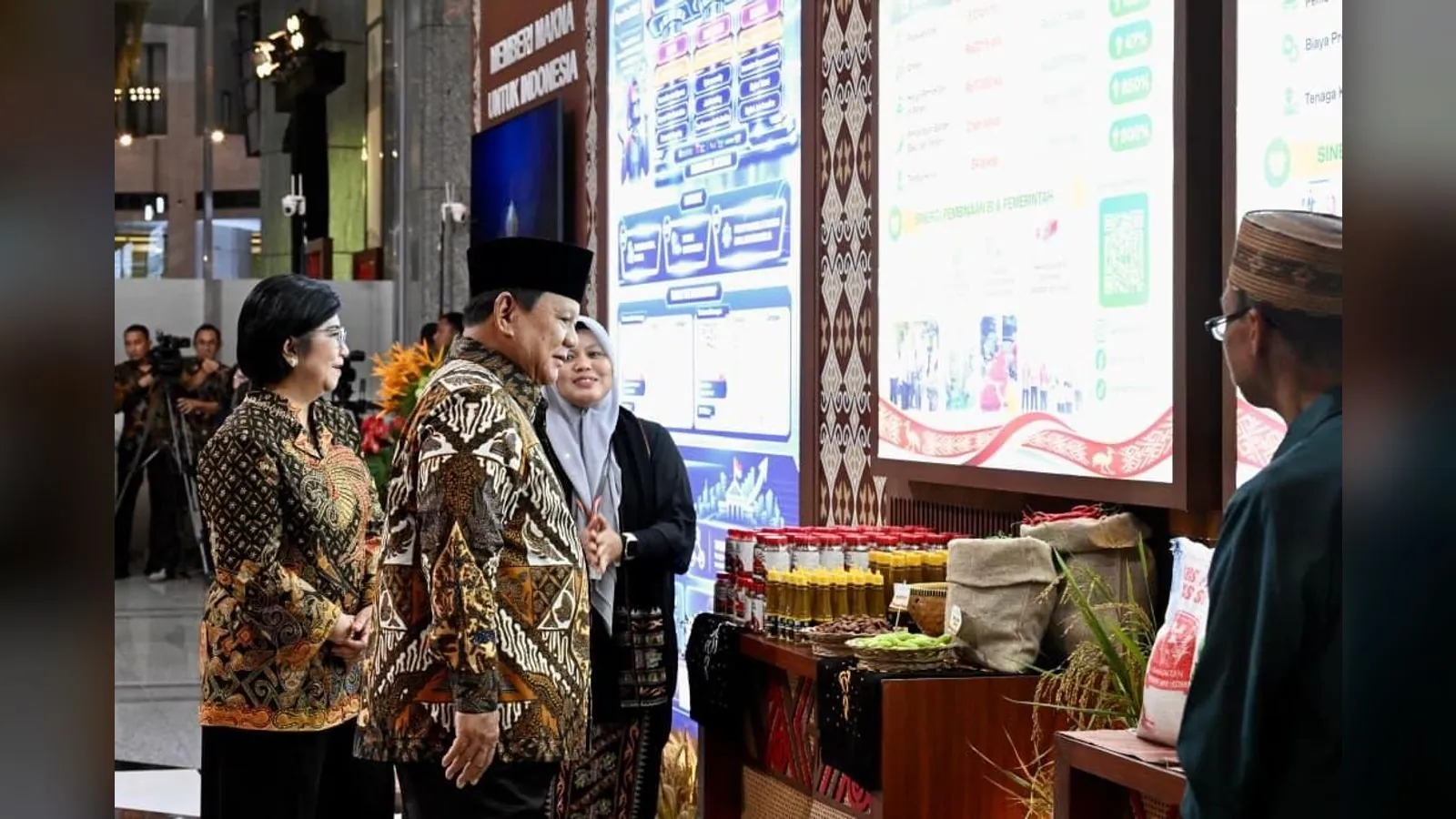
The claim: "Amid global turmoil and uncertainty, we are still grateful that Indonesia's economy was able to grow 5.47% in the third quarter of 2026. This shows that our economy has strong fundamentals." President Prabowo Subianto, speaking at Bank Indonesia's annual meeting in Jakarta on 27 November 2026, as reported by ANTARA.
Verdict: Partly true. The growth figure is correct. The conclusion that it proves "strong fundamentals" is a judgement the data support only in part: growth is running well below the target in Prabowo's own medium-term plan, the fastest-growing part of spending was the state itself, and the rupiah has kept falling past Rp18,000 per dollar.
What the record shows
-
The 5.47% figure is accurate. Statistics Indonesia (BPS) reported that the economy grew 5.47% year on year in the third quarter of 2026, and 5.45% cumulatively from January to September. (BPS)
-
The state was the fastest-growing source of demand. In the same release BPS said government consumption grew 8.95% year on year in the quarter, the highest of any spending component, and 15.09% cumulatively through September. (BPS)
-
That government spending was driven by salaries and free meals. BPS deputy Moh. Edy Mahmud said the rise in government consumption came with higher spending on civil servant pay and allowances, and on goods handed to the public through the Free Nutritious Meals (MBG) programme. Household consumption, the largest component, grew 5.04%. (Kompas)
-
Growth is short of Prabowo's own plan. The 2025 to 2029 National Medium-Term Development Plan, set in Presidential Regulation 12/2025 which Prabowo signed, maps growth of 5.3% in 2025 and 6.3% in 2026, rising to 8% in 2029. (CNBC Indonesia)
-
The government has quietly settled for less. Coordinating Economic Minister Airlangga Hartarto said on 5 November 2026 the full-year target remains 5.4%, "almost the same" as the third-quarter result, well under the 6.3% plan path. (ANTARA)
-
The rupiah tells a weaker story. Bank Indonesia said the rupiah stood at Rp18,145 per US dollar on 2 November, against Rp17,870 during a stronger spell in September, and weakened further to Rp18,245 on 17 November, which BI blamed on global uncertainty and continued foreign selling in Indonesian stocks. (CNN Indonesia, Suara)
-
Jobs are growing, but mostly informal. BPS counted 7.38 million unemployed in August 2026, an open unemployment rate of 4.75%, down from 4.85% a year earlier. The share of informal workers rose to 57.93% from 57.80%. (Kompas)
What the government says
Officials point to international comparisons. Airlangga said third-quarter growth was higher than in most G20 members, listing South Korea at 3.4%, Germany at 1.2% and Japan at 0.7%, with only India, at 7.8%, growing faster among the countries he cited. He said household consumption, which grew 5.04%, remained the main support. (ANTARA) BPS attributed household spending to more online transactions, higher mobility and tourism, and government policies. (Kompas) Bank Indonesia blames the weaker rupiah mainly on outside forces: conflict in the Middle East, tighter US monetary policy and global investors pulling back from emerging-market assets. (CNN Indonesia)
Growth is also uneven across the country. BPS said provinces on Java produced 56.05% of national output in the quarter and grew 5.84%, faster than the national rate, which means the rest of the archipelago grew more slowly. (BPS)
Context
Growth near 5.5% in a year of war in the Middle East and tight US monetary policy is not a weak result, and Airlangga noted it was above most G20 economies. Prabowo also said in the same speech that the country "must not be quickly satisfied" and that growth should be felt "in factories, rice fields, markets and people's homes", not only on paper. (Sekretariat Negara)
But "fundamentals" usually means the parts of an economy that do not depend on a single year's stimulus: private investment, productive jobs, a stable currency. On those measures the record is mixed. A large share of the quarter's extra growth came from the state paying its own staff and funding its flagship meals programme, more than half of workers remain in informal jobs, and the currency has been losing ground since October. Growth is also running about 0.85 percentage point below the path the president's own plan set for this year.
What remains unknown
BPS has not published how many percentage points of growth the MBG programme alone contributed. The government has not explained how it intends to close the gap between the 5.4% budget target and the 6.3% medium-term plan, or whether the RPJMN path will be revised.
Sources
- 1.ANTARA: Prabowo nilai ekonomi RI tumbuh 5,47 persen bukti fundamental kuat, antaranews.com
- 2.BPS: Ekonomi Indonesia Triwulan III-2026 Tumbuh 5,47 Persen (Y-on-Y), bps.go.id
- 3.Kompas: Ekonomi Indonesia Tumbuh 5,47 Persen pada Kuartal III 2026, money.kompas.com
- 4.CNBC Indonesia: Target Ekonomi 2025 di RPJMN & APBN Berbeda, cnbcindonesia.com
- 5.ANTARA: Pemerintah targetkan pertumbuhan ekonomi 5,4 persen sepanjang 2026, antaranews.com
- 6.CNN Indonesia: Bos BI Beber 3 Faktor Tekan Rupiah hingga Tembus Rp18.145, cnnindonesia.com
- 7.Suara: Rupiah Makin Lemah di November 2026, BI Salahkan Faktor Asing, suara.com
- 8.Kompas: Pengangguran di Indonesia Capai 7,38 Juta Orang, Pekerja Informal Meningkat, money.kompas.com
- 9.Sekretariat Negara: Presiden Prabowo: Ekonomi Harus Tumbuh hingga ke Rumah-Rumah Rakyat, setneg.go.id