Key points
- The FAA ordered a nationwide ground stop shortly before 4pm Eastern on 13 November 2026, citing communication issues at regional air traffic control centres.
- Transportation Secretary Sean Duffy said all en route centres were affected, while the FAA said multiple, and the exact number is unresolved.
- No official root cause has been announced. Anonymous accounts of specific faults have not been verified.
- DHS Secretary Markwayne Mullin said there was no indication of a nefarious attack.
- It is the second nationwide stop since 9/11 and came hours after a $30.1bn request to Congress for aviation infrastructure.
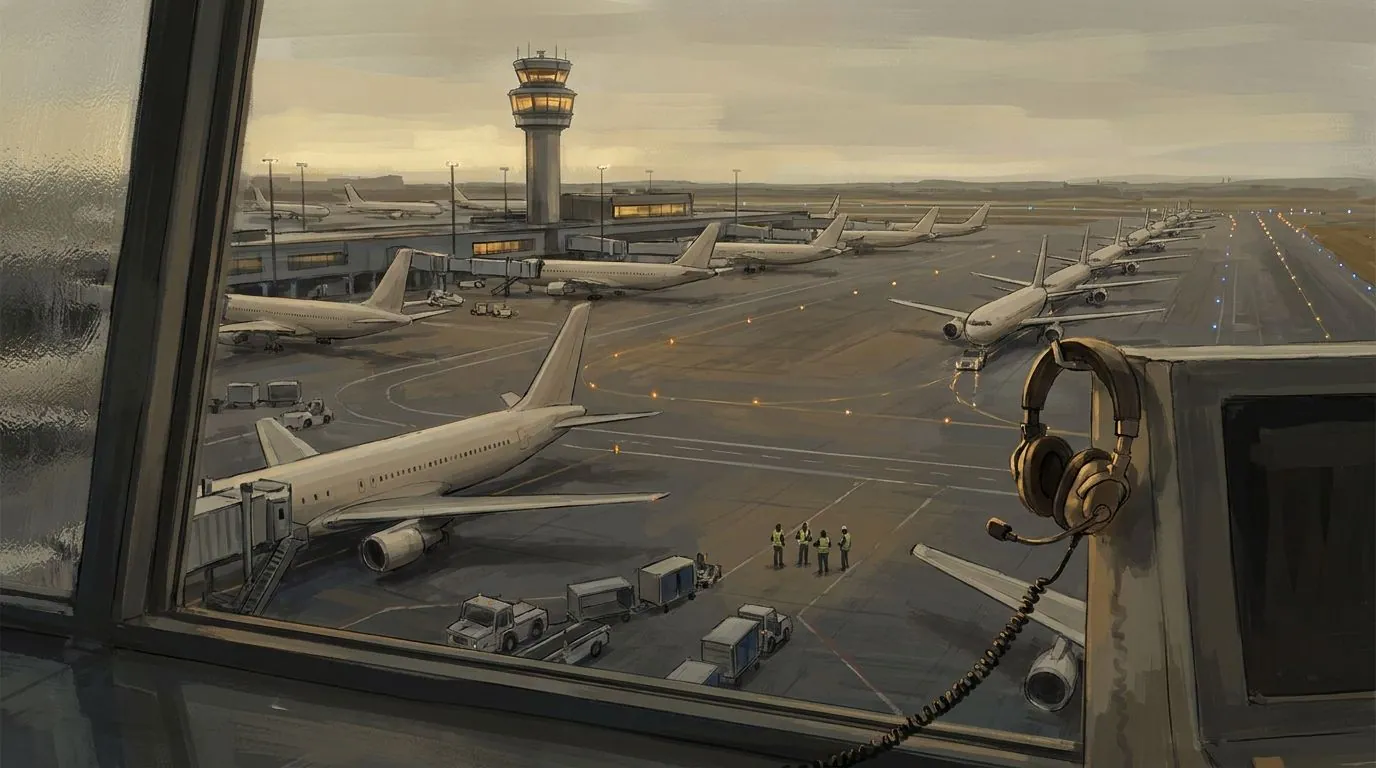
The US Federal Aviation Administration (FAA) ordered a nationwide ground stop for all US airports shortly before 4pm Eastern time on Friday 13 November 2026, according to AeroTime. The FAA said the order followed "communication issues impacting multiple Air Route Traffic Control Centers" and that its technicians were investigating.
The official explanation so far goes no further than a communications failure. The FAA has not named a root cause, and officials have described the scale of the problem differently. NewsWLD has not been able to confirm when departures resumed.
The halt affects travellers beyond the US. The FAA said international flights would be handled case by case, and it came hours after the administration asked Congress for more money to modernise air traffic control.
What the FAA said
In a statement on its website, the FAA said it had issued the ground stop and would provide updates. The order was imposed "due to extraordinary circumstances and for reasons of safety," according to the Associated Press, via PBS, and ABC News.
In a post on X quoted by FedScoop, the FAA called the problem "a temporary telecommunications outage" and said all flights had been halted out of caution. "Every flight has been accounted for and international flights will be handled on a case by case basis," the agency said.
AeroTime reported that the nationwide order followed an earlier halt in Chicago, where controllers had communications problems. Houston's George Bush Intercontinental Airport later confirmed it was holding all departures.
How a ground stop works
A ground stop keeps aircraft at their departure airports. It does not bring down planes already flying. At San Francisco International Airport, spokesman Doug Yakel said aircraft already en route continued to land while departures were held, AeroTime reported.
The FAA also advised crews to expect airborne holding (circling or delays before landing) at airports nationwide because of equipment outages, according to AeroTime. Citing Flightradar24, AeroTime said about 3,100 aircraft were airborne and bound for US airports during the ground stop. That is a snapshot of all US-bound flights in the air at one point, not a count of planes holding. AeroTime said the number actually holding was unclear.
The question of how many centres were affected
Air Route Traffic Control Centers are regional facilities that direct aircraft mainly during the en route portion of a flight, the cruise stage between departure and approach.
The two official descriptions do not match. Transportation Secretary Sean Duffy described "a communication issue impacting all Air Route Traffic Control Centers," according to AeroTime. The FAA's own statement, and an FAA spokesperson speaking to FedScoop, said "multiple" centres. AeroTime said Duffy's initial statement did not identify which system had failed or give a time for departures to resume.
Until the FAA clarifies, the number of centres affected is not settled.
What is not confirmed about the cause
No official root cause has been announced. Some outlets have published accounts from anonymous sources describing specific technical faults. NewsWLD has not been able to verify those accounts, and the FAA has not confirmed any of them.
FedScoop reported that the outage came during broad changes to the FAA's technology. These include the national expansion of an AI-based routing tool called SMART (Strategic Management of Airspace, Routes and Trajectories), the digitising of flight strips and upgrades to analogue communications. FedScoop did not report any link between those projects and the outage, and no verified source has established one.
What the Homeland Security secretary said
Homeland Security Secretary Markwayne Mullin told reporters that planes were grounded "out of an abundance of caution" and that there was "no indication of a nefarious attack," FedScoop reported.
That is a statement about what officials knew at the time. It is not a finding from a completed investigation, and NewsWLD has not verified any further official comment on whether a cyberattack has been ruled out.
How this compares with earlier nationwide stops
According to FedScoop and AeroTime, this is only the second nationwide ground stop since the 11 September 2001 attacks. The AP said it was the first since January 2023.
- 11 September 2001: The FAA halts flights nationwide after the terrorist attacks.
- 11 January 2023: A nationwide ground stop lasting roughly 90 minutes after the FAA's Notice to Air Missions (NOTAM) system, which alerts pilots to hazards, went down. AeroTime said the agency later found contract staff had accidentally deleted files while synchronising the system's main and backup databases.
- September 2026: A construction crew accidentally cuts a fibre line in New Jersey, causing a telecommunications outage, and the FAA suspends flights across the Northeast, FedScoop reported.
- 13 November 2026, earlier in the day: The White House and the Department of Transportation ask Congress for an additional $30.1bn for aviation infrastructure, including $10.1bn for air traffic control upgrades (AeroTime). Traffic in Chicago is halted.
- 13 November 2026, shortly before 4pm Eastern: Nationwide ground stop ordered.
News reports gave varying estimates of when the stop might end. NewsWLD has not confirmed when it was lifted or how quickly schedules recovered.
The funding debate the outage lands in
The $30.1bn request comes on top of existing modernisation work. FedScoop reported that the FAA's current technology upgrades are part of a $12.5bn plan to address long-standing problems, and that transport officials have pressed for more funding as outages have exposed a need for redundancy.
In October, House Democrats asked the FAA to pause the SMART rollout, describing it as rushed and asking about testing and oversight, according to FedScoop.
What to watch next
The main open questions are the root cause, whether backup systems should have kept the centres connected, how many centres lost communications, and when the stop was formally lifted. The outage is likely to feature in congressional discussion of the funding request.
The stop began shortly before the regular 4pm Eastern close of US stock markets, leaving little trading time for any reaction. The fuller response from airline and air cargo shares will show when markets reopen on Monday 16 November.
Why it matters
A nationwide halt to US departures disrupts domestic travel, international connections and air freight. It also exposes weaknesses in air traffic control communications at the moment the administration is asking Congress for $10.1bn in upgrades on top of an existing $12.5bn modernisation plan.
What we know
- The FAA issued a nationwide ground stop for all US airports on 13 November 2026, shortly before 4pm Eastern.
- The FAA cited communication issues affecting multiple Air Route Traffic Control Centers and called it a temporary telecommunications outage.
- The FAA said every flight was accounted for and international flights would be handled case by case.
- An earlier halt in Chicago preceded the nationwide order.
- Flightradar24 data cited by AeroTime showed about 3,100 aircraft airborne and bound for US airports during the stop.
- Mullin said there was no indication of a nefarious attack.
- Hours earlier, the administration asked Congress for $30.1bn for aviation infrastructure, including $10.1bn for air traffic control.
What we don't know yet
- The official root cause of the communications failure.
- Whether all en route centres were affected, as Duffy said, or only some, as the FAA said.
- When the ground stop was formally lifted and how quickly schedules recovered.
- How many flights were cancelled or delayed in total.
- Whether recent changes to FAA systems, including the SMART tool, had any connection. No verified source has established one.
- The effect on air cargo operations.
Market and economic impact
- US air travelDownward pressure
- Departures were held at airports nationwide and airborne flights were told to expect holding. Total cancellation figures have not been verified.
- International flights to and from the USDownward pressure
- The FAA said international flights would be handled case by case, disrupting connections for travellers outside the US.
- Air traffic control fundingUnclear
- The outage came hours after a $30.1bn aviation infrastructure request that includes $10.1bn for air traffic control, and is likely to feature in the congressional debate.
- Airline and air cargo sharesUnclear
- The stop began shortly before the US market close, so the main trading reaction is expected on Monday 16 November.
Sources
- 1.FAA blames telecommunications issue for nationwide ground stop, fedscoop.com
- 2.FAA grounds all flights at U.S. airports due to air traffic control communications problems, pbs.org
- 3.FAA issues rare nationwide ground stop; no indication of 'nefarious attack' - ABC News, abcnews.com
- 4.ATC communications outage impacting flights across US, aerotime.aero